Mosai Pulse & MatrixCare FAQ
Mosai integrates directly with MatrixCare to bring together referrals, clinical insight, and care coordination in one connected experience — helping teams deliver the right care, at the right time, with confidence.
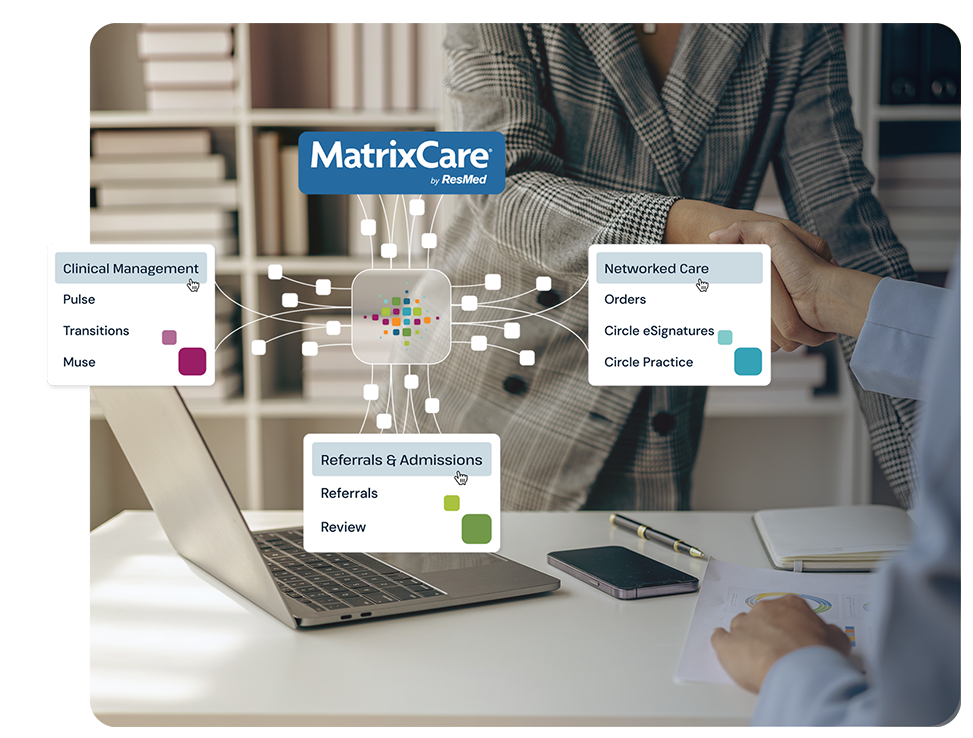
Pulse is a predictive analytics layer that sits on top of your MatrixCare data. It reads clinical and visit data every day and tells your team which patients need attention right now — and why. The result is tighter margin per episode, less manual chart review for your clinical managers, and earlier intervention on the patients most likely to decline. Instead of running reports to find problems after the fact, your team opens one prioritized list each morning.
Yes. Pulse connects directly to MatrixCare, so there's no duplicate data entry and no separate charting. Your clinicians keep documenting in MatrixCare exactly as they do today. Pulse refreshes against that data every three hours, so what your managers see reflects what your clinicians documented this morning — not last week.
Margin and revenue integrity
Throughput and clinician leverage
Clinical quality and value-based readiness
Yes. Medalogix and Forcura came together as Mosai. Pulse is the same predictive model home health organizations have used for years, now part of the broader Mosai platform.
Pulse's predictive model is trained on more than 11 million home health visits. It reads both structured data — OASIS, clinical assessments — and the unstructured narrative in clinical notes, using natural language processing to pick up signals that never make it into a checkbox field.
From that, Pulse stratifies your census into risk tiers with plain probabilities attached. Patients in the highest tier have roughly a 1-in-4 chance of transferring to an inpatient facility within 14 days; the next tier is about 1 in 6, and the tier below that about 1 in 10.
Pulse is designed to augment clinical judgment, never replace it. It tells your team where to look and what's driving the risk. Your clinicians decide what to do about it.
Avoidable inpatient transfers are where clinical performance and financial performance meet. Pulse identifies the patients most likely to decline while there's still time to act — including patients who look ready for discharge but aren't. Across Mosai client agencies in 2025, close to 15% of patients discharged after their first episode had been flagged by Pulse as high risk of ending up in a facility. Without that visibility, those patients leave care without a clear handoff or follow-up plan.
No. MatrixCare stays your system of record. Pulse adds the layer of intelligence on top of it — prioritization, risk, and oversight — so your team spends less time hunting through reports and more time acting on what they find.
Clinical operations leaders and clinical managers use it daily to direct visits and manage census. Finance and executive leadership use it for margin and utilization visibility across the organization. Compliance and quality leaders use it for value-based performance and risk posture. Field clinicians typically don't need to change their workflow at all.
Yes. Mosai has interactive estimators for LUPA exposure, visits per episode, recertification value, and inpatient transfer risk. Enter your average daily census and see the opportunity sized for your organization, here: mosai.com/pulse-use-cases.
Implementation timelines vary with organization size and configuration. A dedicated onboarding team guides your organization through setup, integration, training, and go-live.
Pulse is built around a daily workflow, not a reporting tool your team has to learn to query. Onboarding includes role-based training, educational resources, and ongoing support so managers are working out of Pulse within their normal routine.
Mosai maintains rigorous security, privacy, and compliance standards to safeguard patient information.
Yes. Multi-location organizations get centralized visibility and reporting across branches, with the ability to compare performance team to team and clinician to clinician.
Every Mosai client receives:
Yes, but that's a different product. Mosai Referrals addresses referral leakage and fragmented intake — orders, signatures, and document workflow upstream of the EHR. It's complementary to MatrixCare rather than a replacement for anything in it. Many organizations run Pulse and Referrals together; either one stands on its own.
Size the opportunity against your own census with the Pulse estimators, or talk to someone about what Pulse looks like alongside MatrixCare.