Stop leaving revenue on the table- prevent every LUPA

Prevent Costly LUPAs with Mosai Pulse

Unplanned Low Utilization Payment Adjustments (LUPAs) threaten your agency's revenue and patient care continuity. Mosai Pulse uses machine learning to identify Scheduled and Potential LUPA scenarios in near real time, helping you avoid simple timing oversights and make clinically appropriate decisions. Save time, protect revenue, and ensure the right care at the right time.

 

lupa mgmt card-1
  • Easily generate lists of patients with Scheduled or Potential LUPAs
  • Monitor LUPA thresholds by 30-day period in real time
  • Avoid costly timing oversights and protect your revenue
  • Easily generate lists of patients with Scheduled or Potential LUPAs
  • Monitor LUPA thresholds by 30-day period in real time
  • Avoid costly timing oversights and protect your revenue
How it works

Prevent Costly LUPAs with Mosai Pulse LUPA Management

Unplanned Low Utilization Payment Adjustments (LUPAs) threaten your agency's revenue and care quality. Mosai Pulse delivers near real-time, visit-by-visit insights that help home health teams identify and prevent LUPA scenarios before they occur—ensuring the right care at the right time while protecting your bottom line.

Discover how agencies nationwide are using Pulse to monitor Scheduled and Potential LUPA cases, avoid simple timing oversights, and maintain optimal visit thresholds—all while improving care coordination, reducing hospitalization risk, and maximizing reimbursement.

The Hidden Cost of Unplanned LUPAs

Low Utilization Payment Adjustments (LUPAs) threaten your agency's financial health and clinical quality. When episodes fall below the visit threshold, reimbursement drops — yet prevention remains a persistent challenge.

light gradient 2

Unplanned LUPAs reduce reimbursement by up to 60% per episode


Why this matters: Each LUPA represents significant lost revenue, directly impacting your agency's sustainability and ability to serve your community.

light gradient 1

Simple timing oversights trigger avoidable payment adjustments


Why this matters: Many LUPAs result from scheduling gaps rather than clinical decisions, meaning lost revenue that could have been prevented with better visibility.

light gradient 4

Manual LUPA tracking consumes hours of administrative time weekly

Why this matters: Spreadsheets and manual reviews pull your team away from patient care, while still missing at-risk episodes until it's too late.

Unplanned LUPAs are costing your agency thousands — and they're preventable.

Right now, patients in your census are at risk of falling below the LUPA threshold due to simple scheduling oversights. Each unplanned LUPA means reduced reimbursement and wasted clinical capacity. Without near real-time visibility into scheduled and potential LUPA scenarios, your agency could be operating blind. The impact shows up in lost revenue, inefficient resource allocation, and missed opportunities to deliver the right care at the right time.

Assess your agency's LUPA risk exposure.

LUPA Risk Estimator

How much is your LUPA exposure costing you?

Enter your agency's current LUPA rate and census size to see your estimated weekly exposure — split between scheduled and potential LUPAs — and what that means for your revenue.

This tool estimates population-level exposure. Pulse identifies individual patients at risk — by name, by period, by threshold — so your team can act on the right patient at the right time. Request a demo →
Your Agency
Current LUPA rate 8.0%
Average daily census (ADC)
Your estimated weekly LUPA exposure
Scheduled LUPAs
patients/week
Potential LUPAs
one miss away
Estimated weekly revenue at risk
$0/wk
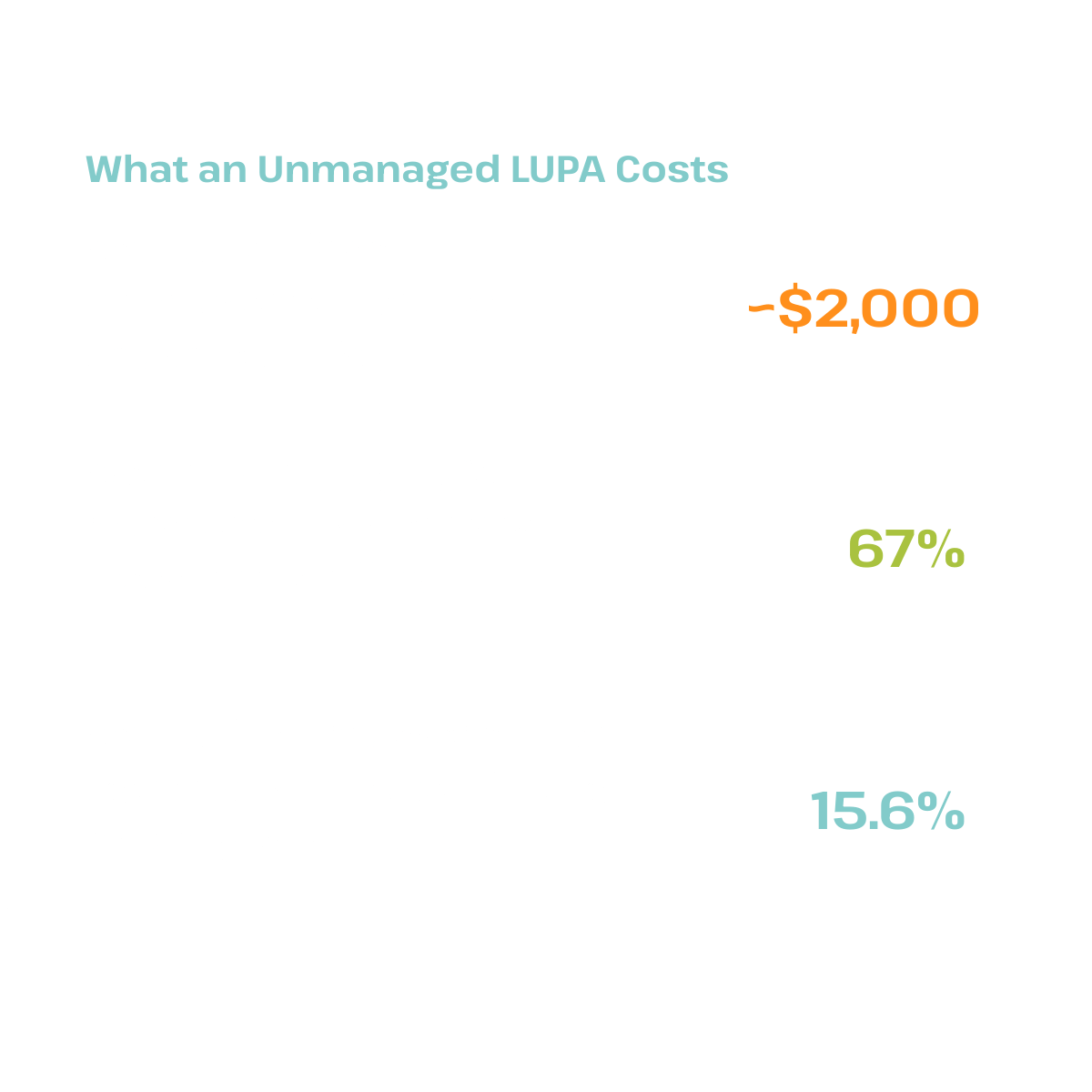
avg ~$2,000/unplanned LUPA
Your opportunity
Adjust the sliders above to see your personalized estimate.

For illustrative purposes. Benchmarks based on CMS data and Mosai client averages. Individual results vary.

Proven Results

The Pulse difference, by the numbers

Agencies using Pulse for LUPA management stop reacting and start preventing — with measurable impact on clinical and financial performance.

15.6%
Average improvement in visits-per-episode alignment
25.8%
Reduction in patients receiving too few visits
8.2%
Fewer unnecessary transfers to inpatient facilities
LUPA Management is one part of the full Mosai Pulse platform
Pulse also covers hospitalization risk, visit recommendations, end-of-episode planning, significant change alerts, gap in care, wound care, and quality review — all in one platform, fully integrated with your EHR.

LUPA Management Throughout the 30-Day Period

Mosai Pulse helps home health teams prevent unplanned Low Utilization Payment Adjustments with near real-time monitoring and visit-by-visit alerts — turning scheduling data into actionable guidance that protects revenue while ensuring clinically appropriate care.


See LUPA Management in Pulse

light gradient 2

Scheduled LUPA Monitoring

Identify patients whose scheduled visits fall below the LUPA threshold, allowing you to review timing and adjust schedules before the 30-day period closes.

light gradient 1

Potential LUPA Alerts

Flag scenarios where scheduled visits exactly meet the threshold, giving you visibility into at-risk episodes that may trigger LUPA due to missed or rescheduled visits.

light gradient 4

Calendar-Based Oversight

View LUPA thresholds by 30-day period directly in the patient calendar, making it easy to spot timing gaps and coordinate care delivery without manual calculations.

card gradient 4

Clinical Appropriateness Review

Access patient risk scores, hospitalization indicators, and care coordination data in one view to determine whether LUPA is clinically justified or requires scheduling intervention.

How Mosai Pulse Prevents Unplanned LUPAs

Near real-time visibility that helps home health teams avoid costly timing oversights


icon (2)


Identify Scheduled and Potential LUPAs

Pulse LUPA Management automatically generates a prioritized list of patients at risk for Low Utilization Payment Adjustments.

Monitor Scheduled LUPA scenarios where scheduled visits fall below the threshold, and Potential LUPA scenarios where visits equal the threshold—giving your team the visibility needed to act before reimbursement is impacted.

Easier Navigation Icon

View LUPA thresholds by 30-day period

Navigate directly to the patient record to view the calendar and LUPA thresholds for each 30-day period. Review clinical context alongside scheduling data to determine whether a LUPA is clinically appropriate or an unintended timing oversight—empowering care coordinators to make informed, compliant decisions quickly.


Faster Document Processing Icon

Save time and protect revenue

By proactively flagging LUPA risk, Pulse helps agencies avoid simple scheduling errors that lead to costly payment reductions. Care teams save hours previously spent manually tracking visit counts and thresholds, while protecting revenue and ensuring patients receive the right care at the right time—every time.

Beyond LUPA Management: The Complete Pulse Solution

Machine Learning That Delivers the Right Care at the Right Time

Mosai Pulse uses rigorously tested predictive models to analyze your census in near real time. Easily generate lists of at-risk patients, monitor LUPA thresholds, review visit calendars, and determine clinically appropriate interventions—all from a single dashboard.