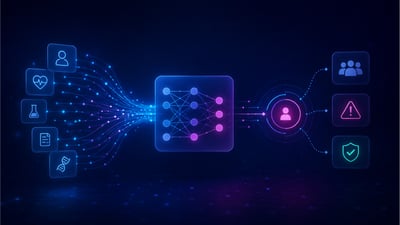
The phrase 'AI-powered analytics' appears in nearly every home health and hospice technology conversation right now. What it actually means — and what it requires to work well — is less consistently understood. Predictive analytics using AI in healthcare is the application of machine learning to historical clinical data to generate forward-looking probability estimates about patient outcomes. In plain terms: the system learns from what happened to patients in the past, identifies the patterns that preceded specific outcomes, and applies those patterns to current patients to flag risk before an event occurs. That is different from what most analytics tools in this space do. Reporting tools summarize what has already happened. Alert tools flag when a data threshold has been crossed. AI-powered predictive analytics works ahead of those thresholds — surfacing risk based on trajectory, not just on a single data point.
What AI Adds to Predictive Analytics
Before machine learning, predictive models in healthcare were largely rule-based: if a patient's weight increased by more than two pounds in 24 hours, trigger a congestive heart failure alert. Those rules can catch known thresholds, but they cannot detect the subtler patterns that precede deterioration — patterns that only become visible when you analyze thousands or millions of patient trajectories simultaneously.
Machine learning does that analysis automatically. Given a large enough dataset, an AI model identifies combinations of variables — vital sign trends, documentation patterns, functional status changes, diagnosis burden — that reliably preceded specific outcomes in historical patients. The model does not need a clinician to write the rule. It finds the pattern in the data.
The result is a predictive capability that can surface risk in patients who appear clinically stable by any single indicator but whose trajectory, read across multiple weeks of longitudinal data, matches a population that historically experienced deterioration.
Why the Data Behind the AI Is What Actually Matters
AI-powered predictive analytics is only as reliable as the data the model was trained on. This is the point most vendor conversations gloss over — and the point that matters most for home health and hospice clinical leaders.
A model trained on general healthcare data — hospital admissions, emergency department visits, ambulatory care populations — learns general healthcare patterns. When that model is applied to home health or hospice patients, it is pattern-matching against a clinical population it did not learn from. The predictions may be generated with statistical confidence. They are not clinically grounded in post-acute care.
Home health and hospice patients have distinct clinical trajectories: extended episodes with longitudinal OASIS assessments, skilled nursing visit documentation across dozens of encounters, functional and cognitive decline patterns that play out over weeks and months. A model that learned from this data understands those trajectories. A model that did not, cannot.
What Predictive Analytics Using AI Looks Like in a Home Health Agency
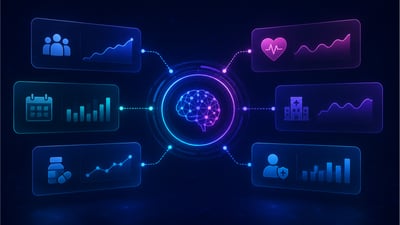
In practice, AI-powered predictive analytics in a home health setting works like this: a clinical supervisor opens a census-level view of their active patient population each morning. Patients are ranked by current risk status — not by last visit date or chart activity, but by what the model has calculated based on each patient's longitudinal clinical record.
The supervisor sees, at a glance, which patients are at elevated risk of hospitalization, which are trending toward a functional improvement benchmark miss, and which require clinical follow-up before their next scheduled visit. That triage is already done. The clinical decision — what to do about it — belongs to the clinician.
This is the operational shift AI-powered predictive analytics enables: from reactive case review to proactive risk management. The information arrives before the event, not after it.
The Question Worth Asking Any Vendor
When a vendor claims their platform uses AI for predictive analytics, the relevant follow-up is straightforward: what was the model trained on, and how much of that training data came from home health or hospice patients specifically?
Vendors with a credible answer can tell you the size of their training dataset, its post-acute specificity, and how the model has been validated against real-world outcomes. Vendors without a credible answer are selling an AI claim, not an AI capability.
For clinical leaders responsible for actual patient outcomes, that distinction is the one that matters.
Learn about the clinical experts behind the outcomes